In the Round or End-On: What the Room Asks of a Scene
Compare in-the-round and end-on staging to see how sightlines, entrances, and shared attention shape a scene before rehearsal begins.
The most common mistake in choosing in-the-round or end-on staging is treating the room as a frame around an already finished scene. The cost is practical: a line that lands cleanly from the front may disappear behind another actor, while a carefully held pause can feel oddly remote. The arrangement of seats changes what a scene asks of its performers.
In an end-on theatre, the audience faces one principal playing area. In the round, seats surround the stage, so performers share the room with spectators on several sides. Neither arrangement is automatically more intimate or more dramatic. Each distributes sightlines, entrances, and attention differently, and those choices matter in Southern theatre spaces from a modest community hall to a purpose-built playhouse.
What does each arrangement make visible?
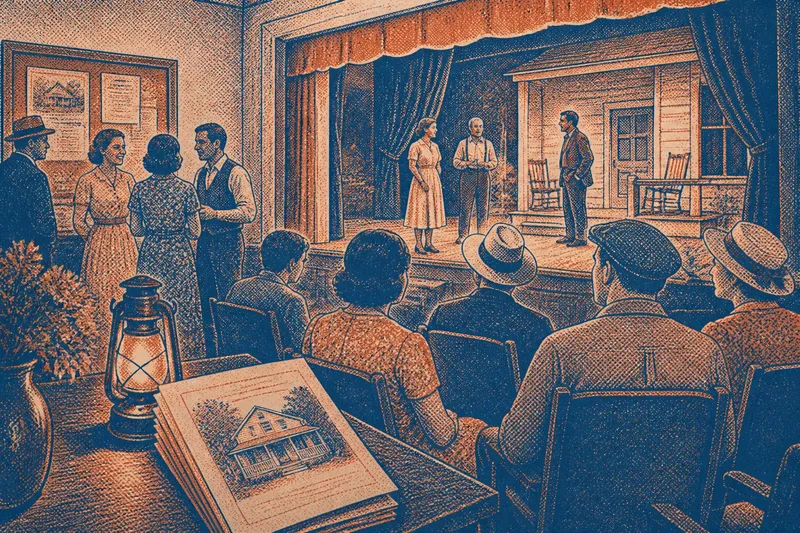
An end-on stage gives the director a clear front. Actors can orient toward a broad audience bank, scenery can establish a strong visual picture, and entrances often arrive from the wings. The audience sees much of the action from a shared direction, though seats at the sides may have a sharper angle on some moments than others.
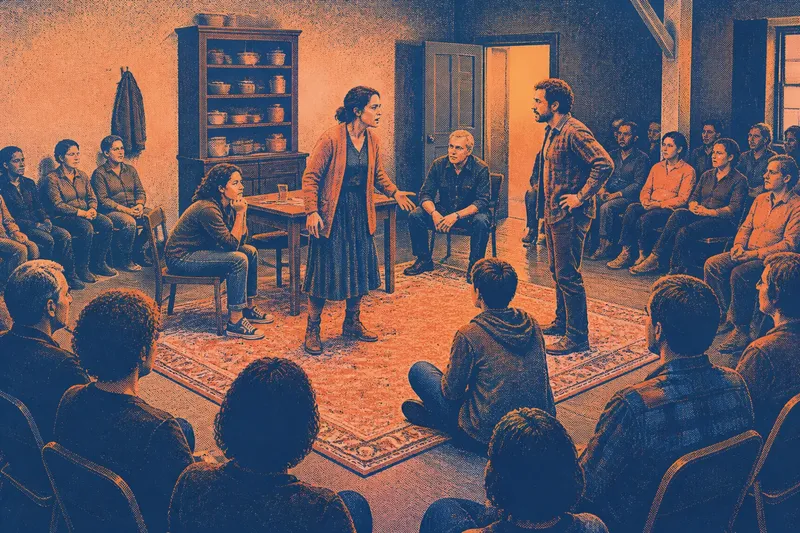
In the round, the stage is surrounded by seating, with aisles or openings often serving as entrances. A performer cannot offer every audience member the same face at once. Instead, the scene becomes a sequence of shifting views: one person sees a profile, another catches a look, and someone across the room may watch an actor’s back.
That variety can make a gathering feel close and alert. It can also make a small gesture hard to read if it is hidden by a partner’s shoulder. The useful question is not whether the audience can see the whole stage from every seat, but whether each important beat remains legible from enough directions.
How do sightlines change blocking?
Blocking is the planned movement and placement of performers. In an end-on space, a director can often use depth—foreground, middle ground, and upstage—to create a composed picture. A table set on a diagonal may let several actors remain visible, while a tightly stacked group can conceal faces behind the person speaking.
In the round, depth still exists, but there is no single front. Actors may need to open a conversation outward, change position as the focus shifts, or leave a clear view across the playing area. Constant turning is not the answer; it can make speech feel mechanically addressed to each section. More often, a grounded body angle and a small change of position let attention travel without calling attention to the adjustment.
Imagine a family argument staged on a square rug in a church fellowship hall. In an end-on arrangement, the director might place the person who has gone quiet near the back of the group, where the audience can watch that reaction. In the round, the same person could sit at the edge of the rug and turn slightly as different relatives speak, keeping the silence visible without making it a display.
Where should entrances come from?
Wings give an end-on scene a useful threshold: a character can arrive from outside the visible world, pause at a doorway, or retreat before the audience sees them go. A set can make those arrivals feel specific, whether the entrance is a kitchen door, a courthouse corridor, or a porch just beyond the light.
In-the-round staging has fewer hidden edges. Entrances may come through aisles, between seating sections, or through a small opening in the set. An actor crossing close to spectators can feel startlingly present, but that route also affects the scene’s rhythm. A long approach may draw attention before the character speaks; a short aisle can make an entrance seem abrupt.
Think about what the audience should know when someone arrives. If the character needs to appear unexpectedly, an aisle may not conceal them from everyone. If the scene depends on the room noticing a newcomer together, that visibility may be exactly the point. The entrance should serve the scene’s information, not simply fill an available gap.
How can performers share attention without losing focus?
Attention is more than facing the speaker. A listening actor can hold a room through stillness, a change in breath, or a decision not to answer. In an end-on setup, the audience often reads those choices along a common axis. In the round, listeners become part of the picture from multiple sides, so a reaction may reach some seats clearly and others only in outline.
That does not mean every performer must continually rotate. It helps to decide where the scene’s center of attention is at each moment, then let posture, distance, and timing make that center visible. A speaker may address one person directly while the rest of the group remains active through attentive listening. When the focus shifts, a step or a turn can carry it more naturally than a series of theatrical gestures.
For a scene with several people talking over one another, an end-on arrangement may make overlapping speech easier to stage as a readable picture. In the round, the same overlap can feel surrounding and immediate, but the performers need to avoid creating a knot that blocks entire sections of the audience. The scene’s intended texture—ordered debate, lively confusion, or mounting pressure—should guide the arrangement.
Which room fits the scene’s main demand?
Consider the scene before committing to a layout. A scene built around a private exchange may benefit from the shared front of an end-on stage, where a director can control how much the audience sees. A scene about a community witnessing a decision may gain force in the round, where no single audience section owns the view.
Ask these practical questions during planning:
- Does a crucial reaction need to remain visible while another character speaks?
- Will a doorway, aisle, or entrance route reveal a character too soon?
- Does the scene rely on a shared visual image, or on several competing viewpoints?
- Can the performers move without repeatedly blocking one another’s faces?
- Does the room offer enough clear paths for entrances and exits?
For instance, say a director is staging a town meeting in a small black-box theatre. If the dramatic turn depends on the entire gathering witnessing one person stand, an in-the-round layout could make that collective attention palpable. If the scene instead centers on a private exchange at the edge of the meeting, end-on staging may help the audience distinguish the intimate conversation from the larger event.
What do playwrights and directors often ask?
Can the same script work in both arrangements?
Often, yes, but movement and entrances may need adjustment. A scene that relies on a character being unseen or on one fixed audience viewpoint may require a more substantial rethink.
Does in-the-round staging require less scenery?
It often favors low, open set pieces because tall scenery can block views across the stage. The right design depends on the room and the play’s needs, not on a rule that every round stage must be bare.
How should a rehearsal account for different seats?
Walk the room from several audience positions and watch the same moment from each. A simple seating map can help the director note where a face, entrance, or important gesture disappears.
Which arrangement feels more intimate?
Either can feel close when performers listen and respond truthfully. The round brings spectators into the action from several sides, while end-on staging can focus attention on a carefully shaped encounter.
What should the room decide?
Choose the arrangement that makes the scene’s central exchange easiest to follow, then let its limits shape the staging. In-the-round or end-on is not merely a question of where chairs go; it determines who can see a reaction, when an arrival becomes apparent, and how attention moves among people. A director who watches from the seats as well as the stage can make those choices concrete—and give the room a reason to be arranged as it is.